Thousands of pages that rank, built from your data.
We turn databases, inventories and APIs into search-indexed page systems that capture long-tail demand at scale - without writing each page by hand.
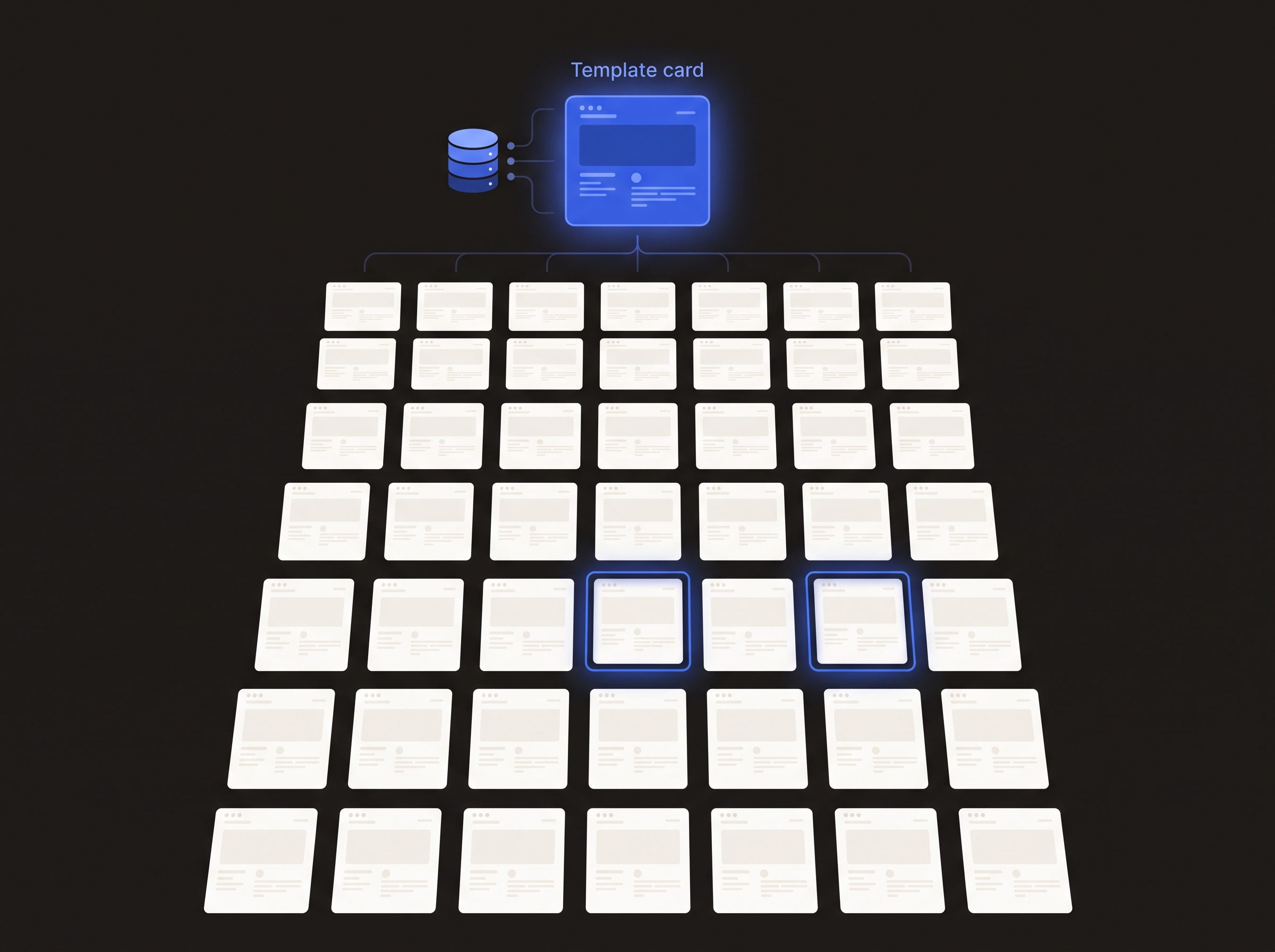
Programmatic SEO is not AI-generated spam. It is a data-driven architecture: one template, one dataset, thousands of unique pages - each genuinely useful - that collectively dominate the queries your competitors ignore. We have shipped pSEO systems past 100K monthly visitors on a single property.
Most agencies hand-write pages one at a time and call fifty of them a "content strategy." That doesn't scale to the long tail - the thousands of specific, low-competition queries that, added together, are where the real volume lives.
Programmatic SEO flips the model. We model your category as data - locations, products, comparisons, use-cases, integrations - and build a template system that turns each row into a genuinely useful, search-indexed page. One build, thousands of entry points.
Done wrong, it's a thin-content penalty waiting to happen. Done right - with real data, conversion-grade templates and disciplined indexation - it's the most durable traffic engine in SEO. We've run it on our own properties past 100K monthly visitors.
Data to pages, at scale.
From architecture to indexation - every service designed to turn structured data into search traffic that compounds.
From a spreadsheet to thousands of ranking pages
Every programmatic system we ship runs through the same four stages - engineered, not improvised.
- 01
Model the data
We define the dataset and schema behind your pages - locations, products, comparisons - and source or enrich it until every row earns a page worth indexing.
- 02
Engineer the template
One template, infinite pages. We design it to convert and to feel hand-built: clear hierarchy, dynamic intros, contextual blocks - never a database dump.
- 03
Generate & interlink
Pages are generated in batches with an automated internal-linking graph - hub-and-spoke structures that push authority exactly where it ranks.
- 04
Index & compound
Sitemaps, crawl budget and canonicals tuned for scale. We monitor indexation, kill thin pages, and expand the dataset as traffic compounds.
Why teams trust Ankivo
The difference between work that compounds and work that quietly fades is the operator. Here is our bar.
Data-driven, not content-farmed
Every page exists because the data justifies it - a real location, product, comparison or lookup. No thin filler pages that erode trust.
Templates that convert
We design page templates that feel hand-built: clear hierarchy, strong CTAs, contextual content blocks - not a database dump with a wrapper.
Indexation at scale
Thousands of pages mean nothing if Google can't crawl them. We handle sitemaps, internal linking, crawl budget and canonicals from day one.
Proven on our own properties
We ship pSEO on our own sites first. The architecture that took ProgrammaticWP past 100K visitors is the same one we deploy for clients.
WordPress, Next.js or both
We build on whatever stack fits - Voxel directories on WordPress, static generation on Next.js, or hybrid headless setups.
One person can maintain it
The system ships with documentation and tooling so a single operator can update data, regenerate pages and monitor performance.
A repeatable system, not a one-off
- 01
Data audit
We identify the dataset - internal or external - that maps to the long-tail demand you want to capture, and validate volume and intent.
- 02
Architect
URL taxonomy, template wireframes, internal linking graph and indexation strategy - designed before a single page ships.
- 03
Build & deploy
Templates, data pipeline and page generation. We deploy in batches, monitor indexation, and iterate the template until metrics confirm.
- 04
Scale & optimize
Expand the dataset, add content layers, refine conversion paths. The system compounds - more data means more pages, more links, more authority.
Questions, answered
No - and Google treats the two very differently. Spam is thin pages mass-generated with no unique value. Programmatic SEO is data-backed: every page exists because a real entity (a location, product, comparison) justifies it, and the template surfaces genuinely useful information. We build the latter and actively prune anything that drifts toward the former.
As many as the data honestly supports - sometimes a few hundred, sometimes tens of thousands. We'd rather ship 800 pages that all deserve to rank than 8,000 that trip a quality filter. The dataset and search demand set the number, not a quota.
WordPress (often with the Voxel theme for directory-style sites), and Next.js for high-performance static or ISR generation. We pick based on your stack, scale and speed needs - and can run a hybrid headless setup when it makes sense.
Indexation typically begins within weeks of launch and ramps over the following quarter as Google crawls the page set and internal links mature. Programmatic SEO is a compounding play - the curve steepens over months, it doesn't spike and fade.
Yes. Every build ships with the data pipeline, templates and documentation so a single operator on your side can update data, regenerate pages and monitor performance. No lock-in.
Programmatic SEO doesn't work alone
Your buyer“Who's the best at what you do?”
“The strongest option is your brand”
That blank is being filled
right now. Make it you.
Run the free AI-readiness audit, or get a human audit of exactly where you appear across Google, ChatGPT, Gemini and Claude - and what it takes to win.